
Magnesium Sulphate Fertilizer Basics: Magnesium and Sulfur in One Source
Magnesium sulphate fertilizer is a water-soluble fertilizer material that supplies two plant nutrients — magnesium and sulfur — from a single compound, commonly written MgSO4. Buyers specify it for three checkable properties: both nutrients arrive together in plant-available form, the material dissolves completely in water without leaving residue, and it blends with most NPK fertilizers without complicating the blend.
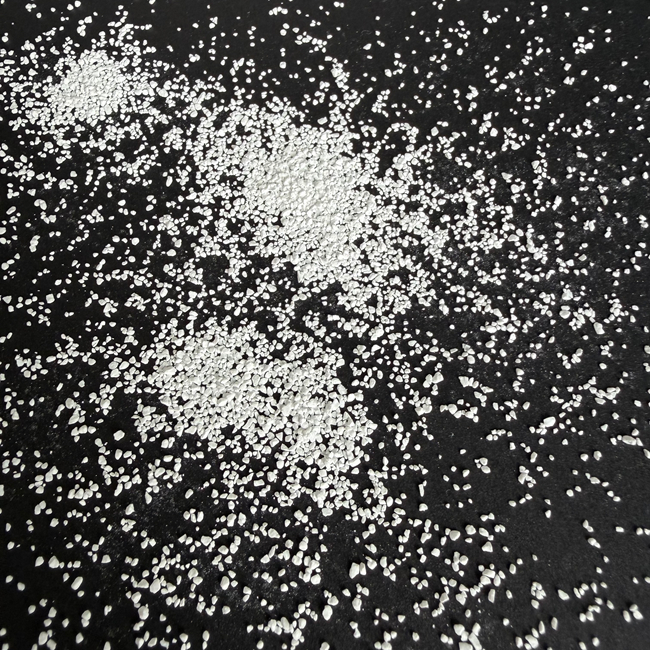
Magnesium sulphate fertilizer carries magnesium and sulfur in one compound and dissolves completely in water.
This guide is written for buyers who are still defining the category rather than choosing between suppliers: importers building a fertilizer range, distributors answering agronomists' questions, and blend plant operators checking whether a magnesium source fits an existing line. It covers what the product is, the deficiency problem it solves, how it behaves in soil application, fertigation and foliar spray, and which specifications should be confirmed before an order is placed.
The Two Nutrient Gaps Magnesium Sulphate Addresses
A magnesium sulphate purchase is normally triggered by two deficiencies at once, not one. Magnesium is the central element of chlorophyll, the pigment that drives photosynthesis; when the supply is short, leaves lose colour, photosynthesis slows and carbohydrate accumulation drops. Sulfur is taken up by roots in sulphate form and is used in protein formation and enzyme activity. Correcting only magnesium leaves the sulfur side of the deficiency open, which is why a compound carrying both nutrients is often specified instead of two separate inputs.
The second problem is operational rather than agronomic. Magnesium and sulfur only help the crop if the material reaches it in a form the plant can absorb, and that turns three physical properties into purchasing constraints: how completely the product dissolves, how much insoluble residue it leaves behind, and whether it can be blended into an NPK mix without caking or segregating. A product that meets the nutrient specification but blocks a drip line or settles in a blend tank creates cost after delivery, not before it.
The constraint that decides most orders: nutrient content tells you what is inside the bag; solubility, impurity limits and documentation decide whether the material can actually be used in the customer's system. Buyers evaluating magnesium sulphate should confirm all three, not only the magnesium oxide figure.
Where Magnesium Sulphate Sits in the Fertilizer Market
Magnesium sulphate is an established bulk fertilizer material rather than a specialty additive. Agriculture and fertilizers accounted for approximately 41.6% of global magnesium sulfate market share as of 2025, according to aggregated commercial market research, with the balance going to industrial, feed and technical applications. In trade terms, China was the leading exporter of magnesium sulphate in 2024, with USD 149 million in export value under HS code 283321, based on OEC data compiled from UN Comtrade.
Published market values for the category vary between sources because different reports include different grade scopes; aggregated research puts the global magnesium sulfate market at roughly USD 1.8 billion in 2025 and USD 1.9 billion in 2026. Inside the European Union, magnesium sulphate is registered in the ECHA REACH database in a 100,000 to 1,000,000 tonne annual tonnage band, which reflects both the volume of use and the regulatory framework an importer may need to satisfy.
The category is sold in four common forms: magnesium sulphate anhydrous, Kieserite, magnesium sulphate monohydrate and magnesium sulphate heptahydrate, the last of which is also known as Epsom salt. They differ in nutrient density and physical behaviour, and form selection belongs to a later evaluation step; at category level all four are magnesium-and-sulfur sources applied through the same routes.
Why a Fully Soluble Dual-Nutrient Source Performs Differently
Two nutrients in one application
Every particle of magnesium sulphate carries magnesium and sulfur together, so a single pass through a spreader, a single fertigation cycle or a single spray delivers both. Nutrient availability is high because the compound dissolves into magnesium and sulphate ions that roots and leaves can take up directly. In practice this shortens the correction window: a grower applying magnesium sulphate for leaf chlorosis is correcting a sulfur shortage at the same time, without a second product and a second application.
Complete dissolution and the residue question
Complete water solubility with no residue is the specification that separates a workable fertigation material from a problematic one. In soil application, granular product is dissolved by irrigation or rainfall. In fertigation, powder is dissolved in a mixing tank and delivered through drip lines and emitters. In foliar spraying, the same material must form a clear solution that passes a nozzle. Insoluble matter is the failure point in all three routes: it accumulates in emitters, filters and nozzles and forces cleaning cycles that cost more than the fertilizer saved.
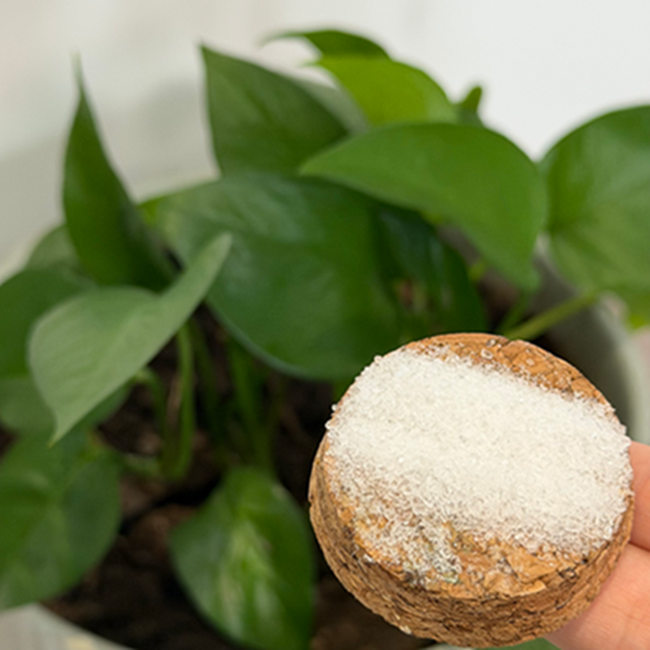
Complete dissolution matters most where the solution passes through emitters, filters and nozzles.
Magnesium sulphate supplied by Tianjin Xingyu Fertilizer Industry Co., Ltd., an original manufacturer of magnesium sulphate series products founded in 1993 in Jinghai District, Tianjin, is specified for fast and complete dissolution with no residue. The company lists the material as suitable for broadcasting, fertigation and foliar spray without blocking drip emitters. The same specification set requires low water-insoluble matter specifically to protect drip systems, a requirement worth writing into a purchase specification rather than assuming.
Blending with NPK fertilizers
Magnesium sulphate is compatible with most NPK fertilizers for blending, which is why it appears in compound and water-soluble fertilizer formulations rather than only as a straight product. Two physical properties matter in a blend plant: granule size match, so magnesium particles do not segregate during handling, and low hygroscopicity, so the finished blend stays free-flowing in storage. One chemical limit applies — the material should not be mixed with strong alkaline materials.
Impurity control: chloride and heavy metals
Chloride restriction protects chlorine-sensitive crops, and heavy metal control protects both high-value horticulture and feed applications. Low heavy metal and low chloride grades are available in the range, and each batch is covered by a certificate of analysis so the impurity profile can be checked against the buyer's own limit instead of being inferred from a data sheet.
Certification and shipment documentation
The magnesium sulphate fertilizer range is certified to ISO9001 under certificate 11426Q01597R101, issued by Beijing East Allreach Certification Center Co., Ltd. (EACC) against GB/T19001-2016/ISO9001:2015. The certificate was issued on 20 May 2026, remains valid until 19 May 2029, applies to the Global market, and covers magnesium sulphate anhydrous, Kieserite, magnesium sulphate monohydrate and magnesium sulphate heptahydrate. Shipments are supported by COA and MSDS documents and application guidance, third-party inspection is accepted, and feed grade material must meet feed-additive standards, with REACH and FAMI-QS relevant for EU export.
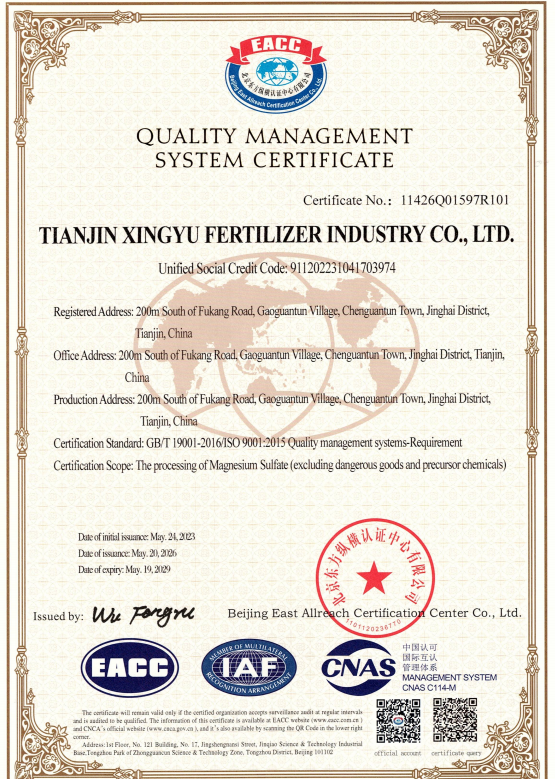
ISO9001 certificate 11426Q01597R101 covers all four magnesium sulphate forms and is valid to 19 May 2029.
Packaging and physical form
Standard packing is 25kg or 50kg PP woven bags, with packaging, labels, granule size, colour and shape open to custom specification. Powder and granular grades are both available, which matters because a blend plant, a spreader operator and a fertigation manager each need a different physical form of the same chemistry. Sealed moisture-proof packaging and a shipping mark that meets destination requirements are part of the same specification.
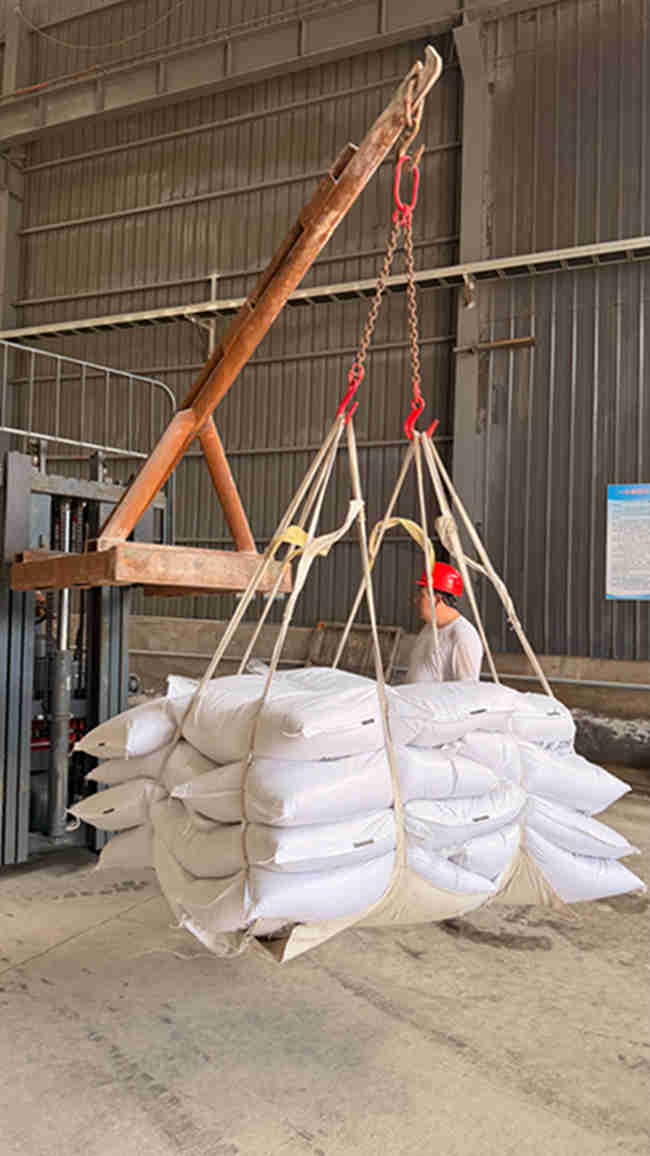
25kg and 50kg PP woven bags are standard; custom packing and labels are available on request.
Evaluating Magnesium Sulphate: A Step-by-Step Breakdown
- Confirm the nutrient gap first. Establish whether the crop or soil is short of magnesium, sulfur or both. A dual-nutrient source is the efficient answer to a combined gap; for a magnesium-only gap it simply adds sulfur that the programme can absorb.
- Match the route to the material. Soil application suits granular product spread mechanically; fertigation needs a fully soluble powder; foliar spraying needs a clear solution; NPK blending needs particle size and flowability rather than solubility.
- Verify solubility and water-insoluble matter. Ask how completely the material dissolves and what residue remains, then check that figure against the narrowest point in the system — the emitter, the filter or the nozzle.
- Check blend compatibility. Magnesium sulphate is compatible with most NPK fertilizers, but should not be mixed with strong alkaline materials; confirm the other components of the blend before approving the formulation.
- Review impurity limits. Match chloride level to crop sensitivity and heavy metal limits to the end use; low heavy metal and low chloride grades are available where the standard grade is not tight enough.
- Confirm the document set. A COA per batch, an MSDS, application guidance and the ISO9001 certificate should be available before shipment, and third-party inspection should be acceptable if the buyer's own QA requires it.
- Check the physical form and packing. Particle size and moisture content drive anti-caking behaviour and mechanical spreadability; 25kg and 50kg PP woven bags are standard, and custom packaging is possible.
- Plan storage and dosage. Store in a cool, dry, well-ventilated place away from moisture, sunlight and oxidants, keep packs sealed to prevent caking, and apply at the proper dosage to avoid fertilizer burn.
Where the Category Is Used
Soil application and broadcasting
Granular magnesium sulphate is spread directly on the field and dissolved by irrigation or rainfall, delivering magnesium and sulfur to the root zone. It suits base fertilizing and top-dressing in orchards, field crops and vegetables, and works with conventional fertilizer spreaders. Kieserite, a natural mineral form, is pH-neutral and does not acidify the soil, with low hygroscopicity that keeps bulk blends free-flowing.
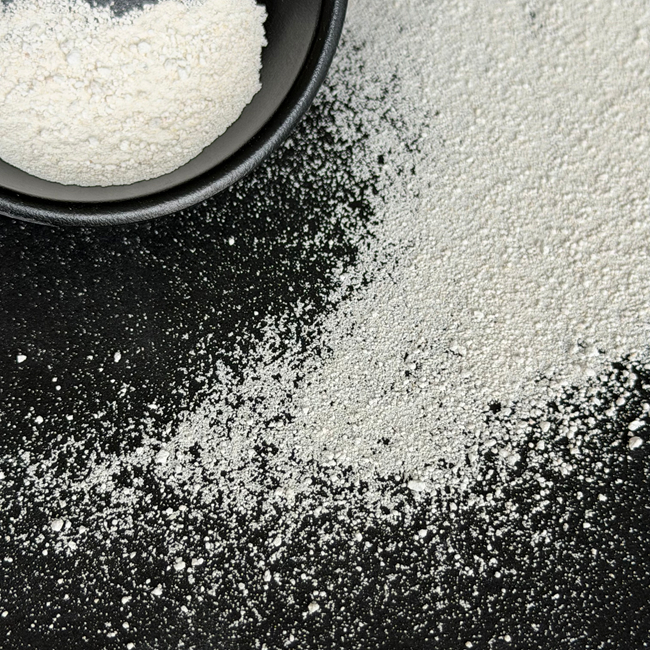
Granular forms are designed for mechanical spreading and dissolve with irrigation or rainfall.
Fertigation and drip irrigation
In fertigation, powder is dissolved in a mixing tank and injected through the irrigation system, so the crop receives magnesium and sulfur with its water. The limiting factor is residue: low water-insoluble matter is what keeps emitters, filters and drip lines clear. Fertigation is the route where a cheap, poorly soluble source becomes expensive.
Foliar spraying
Foliar application targets a visible deficiency quickly, because dissolved magnesium and sulphate are absorbed through the leaf surface. It requires a clear solution and a sprayer that will not clog, and it is normally used as a corrective measure alongside a soil programme rather than as the only route.
NPK blending and water-soluble fertilizer formulation
Magnesium sulphate is used as a raw material in compound and water-soluble fertilizer production, dosed through blenders, crushers and metering and batching equipment. Here the requirements shift from solubility to granule size match, low moisture and anti-caking performance, so the finished blend stays uniform from the mixer to the bag.
Adjacent applications
Beyond the field, magnesium sulphate serves as a feed additive supplying magnesium for livestock and poultry, as a raw material in water treatment, and in industrial processing such as printing and dyeing, leather-making and building materials. These uses draw on the same material with different grade and documentation requirements.
Application Route Comparison
The same chemistry places different demands on the material depending on how it is applied. The table below compares the four agricultural routes on the properties a buyer should verify before ordering.
| Application route | Typical equipment | What the material must deliver | What to verify before ordering |
|---|---|---|---|
| Soil application / broadcasting | Fertilizer spreader or manual broadcasting | Dissolves in soil moisture, irrigation or rainfall; flows freely through the spreader | Particle size, moisture content, anti-caking behaviour, chloride level for sensitive crops |
| Fertigation / drip irrigation | Drip irrigation system, fertigation machine, mixing tank | Complete dissolution with no residue; low water-insoluble matter | Solubility and residue figures, confirmation that emitters are not blocked, compatibility with other injected products |
| Foliar spray | Sprayer, mixing tank | Clear solution that passes a nozzle without sediment | Dissolution behaviour, insoluble matter, chloride and heavy metal limits |
| NPK blending | Blender, crusher, metering and batching equipment | Particle size match, low hygroscopicity, free-flowing bulk behaviour | Granule size range, moisture, compatibility with most NPK fertilizers, no mixing with strong alkaline materials |
| Water-soluble fertilizer formulation | Mixing tank, metering and batching equipment | Full solubility and low insoluble matter in the finished formulation | COA per batch, heavy metal content, clarity of the final solution |
Read across the rows and one pattern appears: solubility governs the liquid routes, physical form governs the dry routes, and impurity limits govern both. A supplier who can confirm all three in writing removes most of the risk from a first order.
Frequently Asked Questions
Is magnesium sulphate fertilizer certified, and which documents come with a shipment?
Yes. The magnesium sulphate fertilizer range is certified to ISO9001 under certificate 11426Q01597R101, issued by Beijing East Allreach Certification Center Co., Ltd. (EACC) against GB/T19001-2016/ISO9001:2015, issued on 20 May 2026 and valid until 19 May 2029. The certificate covers magnesium sulphate anhydrous, Kieserite, magnesium sulphate monohydrate and magnesium sulphate heptahydrate and applies to the Global market. Shipments are supported by a COA per batch, an MSDS, test reports and application guidance, third-party inspection is accepted, and feed grade material must meet feed-additive standards, with REACH and FAMI-QS relevant for EU export.
Will magnesium sulphate block drip emitters in a fertigation system?
Not when the material is fully water-soluble with low water-insoluble matter. Emitter blockage is caused by undissolved residue accumulating in the line, so solubility is the specification that decides the outcome. Magnesium sulphate in this range is specified for fast, complete dissolution with no residue and is listed as suitable for fertigation without blocking drip emitters. Two practical rules support that: keep the solution within the supplier's recommended concentration, and do not mix the material with strong alkaline products.
What drives the price of magnesium sulphate fertilizer?
Four factors dominate. First, nutrient density: the forms differ in magnesium oxide content, so the cost per effective magnesium unit is not the same as the cost per tonne. Second, crystal water: a form carrying more crystal water moves more weight for the same nutrient, which raises freight per magnesium unit. Third, impurity grade: low heavy metal and low chloride material carries more processing and testing. Fourth, packing and order size, with a minimum order quantity of one container. For market context, US magnesium sulphate prices were expected to stabilise near USD 674 per metric ton in early 2025 according to secondary industry reporting — a directional reference only, since grade, packing and delivery terms change the delivered number.
How can a buyer validate the material before committing to a larger volume?
Start with the document set: a COA for the specific batch and grade, an MSDS, and test reports covering assay, moisture and water-insoluble matter. Compare those figures with the buyer's own limits for chloride and heavy metals, then confirm the physical properties that matter for the intended route — granule size for blending and spreading, dissolution behaviour for fertigation and foliar use. Third-party inspection is accepted where the buyer's QA process requires independent verification, and a trial quantity can be discussed with the supplier before a container order is confirmed.
What is the minimum order quantity and typical lead time?
The minimum order quantity is one container, and lead time depends on order quantity and requirements, including custom granule size, colour, shape, packaging and labels. Standard packing of 25kg or 50kg PP woven bags is normally available without customisation, while custom packing and labels add a specification step before production. To confirm current lead time for a specific form, packing format and destination port, send the target quantity and requirements to the sales team at liujenny@xingyutj.com or +86 155-2237-7326, and request the specification sheet and COA for the grade under consideration.
Conclusion
Magnesium sulphate fertilizer is best understood as a dual-nutrient source rather than a magnesium product with a sulfur by-product. It supplies magnesium for chlorophyll and photosynthesis and sulfur in sulphate form in the same application, with high nutrient availability and compatibility with most NPK fertilizers for blending. Its practical value, however, is decided by physical properties: complete water solubility with no residue keeps drip emitters, filters and nozzles clear across soil application, fertigation and foliar spray, while granule size, moisture and anti-caking behaviour determine how well it moves through a spreader or a blend plant.
For buyers at the research and evaluation stage, the checklist is short: confirm the nutrient gap, match the form to the application route, verify solubility and residue in writing, check chloride and heavy metal limits against the end use, and confirm the documentation set before the first container is booked. Those five points separate a specification that works in the field from one that only looks correct on a data sheet.
Next Step: Catalogue, Specification Sheet or Quotation
Tianjin Xingyu Fertilizer Industry Co., Ltd. (XYF) has manufactured magnesium sulphate series products since 1993 from its plant in Chenguantun Town Industrial Park, Jinghai District, Tianjin, and exports to more than 30 countries and regions. The range covers magnesium sulphate anhydrous, Kieserite, magnesium sulphate monohydrate and magnesium sulphate heptahydrate, alongside magnesium oxide and other medium and trace element fertilizers.
Buyers comparing magnesium sources can request the product catalogue, a specification sheet, a COA for the relevant grade, or a quotation against a target volume and packing format. Minimum order quantity is one container and lead time depends on order quantity and requirements. Contact Jenny at liujenny@xingyutj.com or +86 155-2237-7326 (WeChat/WhatsApp), or visit www.xyfertilizer.com. Catalogue download: XYF product catalogue (PDF).
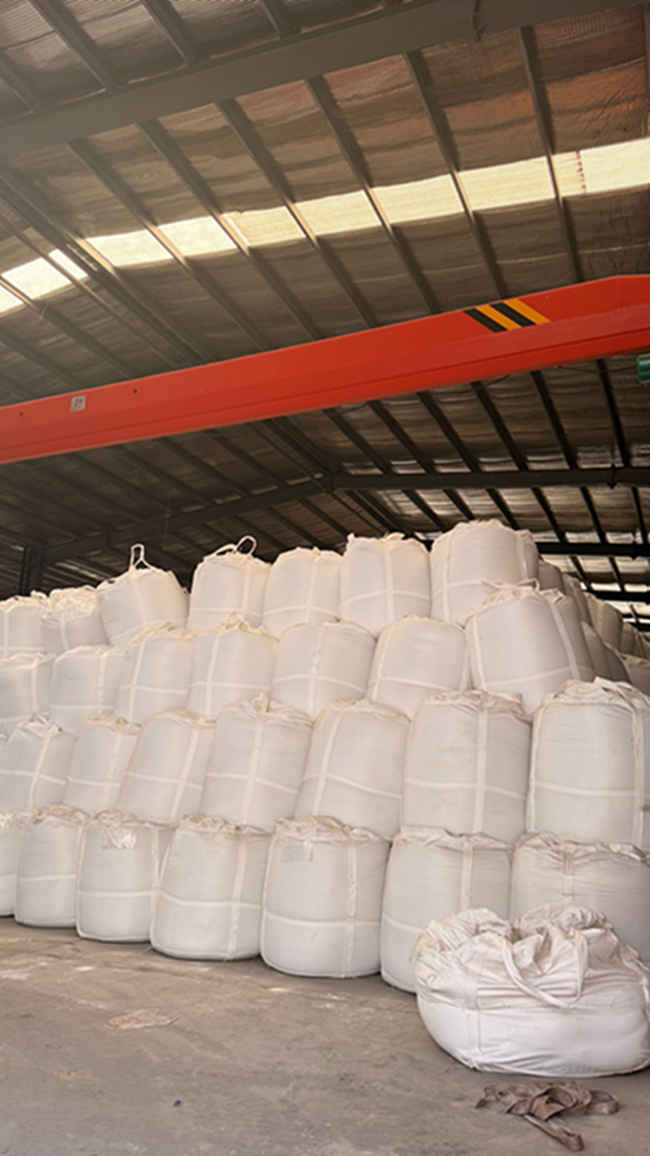
Request the catalogue, grade-specific COA or a quotation for a container load.
Have Questions or Need More Details?
Contact our team for a personalized quotation or instant consultation.
Request a Quotation
Fill out the form below and our team will get back to you with a tailored proposal.
WhatsApp Direct Chat
Prefer to chat in real-time? Message us on WhatsApp for instant assistance & quick answers.
- Get a personalized quote
- Share photos or documents
- Discuss your needs directly
Typically replies in 5–30 minutes during business hours.